Economy
Halifax Stanfield International Airport to Enhance Passenger Connections with New Facility


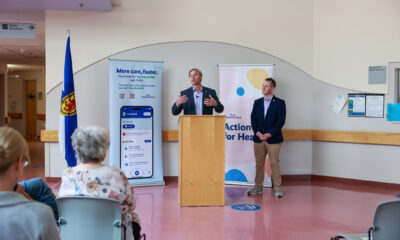
Halifax Stanfield International Airport is set to offer faster and more efficient passenger connections with the construction of a new international connections facility.
The announcement was made recently, highlighting the importance of the airport as a transportation and trade hub for Nova Scotia, Canada, and North America. Kim Masland, Minister of Public Works, emphasized the significance of the investment, stating, “This investment will help ensure the airport can keep supporting travellers and trade as our province continues to grow.”
The new facility aims to streamline passenger connections for those arriving in Canada from other countries and connecting to domestic flights. Additionally, it will increase cargo capacity, facilitating the efficient movement of goods between Nova Scotia and international markets.
The project, estimated to cost $18 million, will see a substantial financial contribution from multiple sources. Tim Houston’s PC Government is investing $3 million, the federal government is providing $8.4 million, and the Halifax International Airport Authority is contributing $6.6 million.
This development is expected to bolster the airport’s capabilities, supporting the region’s growing needs and enhancing its role in international travel and trade.


Nova Scotia is set to strengthen its agri-food sector with a significant investment from Agropur dairy co-operative, as the business moves forward with a major expansion of its Bedford facility. The project is expected to bolster the province’s dairy industry while creating skilled-trade jobs during the construction phase.
Premier Tim Houston praised the decision, highlighting the alignment between Agropur’s growth strategy and the province’s broader economic goals.
“Nova Scotia is a great choice for Agropur’s expansion,” said Houston. “Agropur’s strong commitments to market diversification and growth align with our government’s plan to grow our economy and support the success of our people.”
It’s fantastic to see businesses like Agropur investing in our province. Just yesterday, they announced an expansion of their Bedford facility: creating good, skilled-trades jobs and growing our dairy sector right here at home. Minister Greg Morrow was proud to help ensure this… pic.twitter.com/4TMS41huWK
— Tim Houston (@TimHoustonNS) April 24, 2026
Once complete, the upgraded Bedford site will serve as a key dairy ingredient processing hub. It is positioned to play a strategic role in supplying locally produced dairy proteins to meet rising national demand for protein-enriched products. The expansion will also introduce a new butter processing line, further enhancing production capacity.
The new facility is expected to open in 2028, marking a long-term investment in the region’s agricultural and manufacturing sectors.
Agropur already has a strong presence in Nova Scotia, employing more than 400 people across its Bedford and Truro operations. The expansion is anticipated to reinforce that footprint while supporting dairy farmers throughout Nova Scotia and the broader Maritime region.
Agriculture Minister Greg Morrow emphasized the importance of the project for local producers and the industry’s future.
“This is a great day for dairy farmers in Nova Scotia,” said Morrow. “The new plant is a strategic investment in local milk and milk products and will support the industry in looking at value-added projects and market and product diversification.”
The development signals growing confidence in Nova Scotia’s agri-food sector and its ability to compete in evolving domestic markets–thanks to investments from the province’s PC government.

Nova Scotia graduates will no longer need to reapply each year to keep their provincial student loans interest-free, following a new change aimed at reducing paperwork and improving access to support.
The PC government has streamlined its zero per cent interest program so that all new graduates who qualify will automatically continue receiving the benefit throughout their repayment period. The update removes the previous requirement for borrowers to submit annual applications to confirm eligibility.
We’re making it easier for Nova Scotia graduates to get ahead.
— Tim Houston (@TimHoustonNS) April 14, 2026
Our government has removed the need to reapply each year to keep provincial student loans interest-free. That means less paperwork and no risk of losing support.
✔️ 0% interest continues automatically
✔️ Fewer… pic.twitter.com/0wRbD5ZPbM
“Graduates should be able to focus on the new, exciting stage they are starting – not worrying about whether they have filled out the paperwork to keep loan repayment affordable,” said Brendan Maguire, Minister of Advanced Education. “By removing the need to reapply each year, we’re making the zero per cent interest program simpler and more reliable for the Nova Scotians who depend on it.”
The program is designed to support graduates who choose to stay in Nova Scotia after completing their studies. Until now, participants were required to reapply annually to verify they still met the criteria, creating an added administrative step that could interrupt support if missed.
With the new approach, eligible borrowers will experience uninterrupted access to interest-free repayment, helping them stay focused on paying down their loans. The Province has already notified individuals currently repaying provincial student loans of the change via email.
Officials say the update is part of a broader effort to cut red tape and improve service delivery across government programs, making it easier for Nova Scotians to access the support they need.

Atlantic Mining Nova Scotia has received approval to begin new work at the Touquoy gold mine site in Moose River, Halifax County, allowing the company to process previously stockpiled ore.
The industrial approval, issued April 10 by the PC government’s Department of Environment and Climate Change, permits the processing of approximately three million tonnes of gold-bearing ore that has remained on site since operations ceased in 2023. No new mining or extraction will take place, and all work will be limited to the site’s existing disturbed footprint.
Processing is expected to take between 10 and 14 months. As part of the plan, all resulting waste material will be returned to the site’s existing open pit.
The project is expected to deliver economic benefits to the province, including the creation of about 197 jobs and an estimated $151 million contribution to Nova Scotia’s gross domestic product.
Last week our government announced that industrial approval has been granted to process existing gold ore at the Touquoy site in HRM.
— Tim Houston (@TimHoustonNS) April 14, 2026
This work will support nearly 200 jobs and add $151 million to Nova Scotia’s economy.
There is no new mining or expanded footprint. This project… pic.twitter.com/BNpifoctP9
Reclamation of the Touquoy site began in 2024 and will continue during this phase of work. While activity in the mill area will be temporarily paused to allow for processing, cleanup efforts will proceed in other parts of the site.
To ensure the site is fully restored, the Province continues to hold a $79.9-million bond from Atlantic Mining. The bond is in place to guarantee that reclamation is completed in accordance with the Environment Act.
The approval allows previously extracted resources to be processed while maintaining environmental safeguards and ongoing site rehabilitation.